

How to Explain a Technology Problem When You Do Not Know the Tech Terms

What should you say when you need technology help?
Start with the business symptom: the task that is slow, repeated, confusing, or easy to miss. Add who does it, how often it happens, and what goes wrong when it does. That is enough for a useful first conversation. You do not need to name a CRM, automation platform, database, or programming language.
The person who runs the workflow knows things a product page cannot show: the exceptions, handoffs, and small workarounds that keep the business moving. Your job is to describe those realities. The technology partner’s job is to help map them to possible solutions.
Start with the task that keeps breaking
Finish one of these sentences:
- “I am tired of…”
- “Every time we…, we have to…”
- “The part that gets missed is…”
- “I wish we could see…”
- “We know this information exists, but…”
Then fill in this short worksheet:
| Question | Your notes |
|---|---|
| Who does the task? | |
| What starts it? | |
| What happens, step by step? | |
| How often does it happen? | |
| What goes wrong or takes too long? | |
| What would “better” look like? |
The goal is not to produce a perfect requirements document. It is to make the current workflow visible enough to discuss.
Examples of useful problem descriptions
These are illustrations of how to describe a problem, not client results or promises about a particular solution.
Double entry: “When a new customer contacts us, we copy the same details between email, a spreadsheet, and our invoicing tool. I want to know where the information should live and how to avoid retyping it.”
Missed follow-up: “A lead may call while we are on a job. We write the number down, but there is no reliable next step. I want a simple way to make sure someone owns the follow-up.”
Unclear lead sources: “We receive calls, form submissions, and referrals, but the information is recorded differently. I want to understand which sources are producing real opportunities before changing our marketing.”
Notice that each example describes a workflow and a decision that needs to be made. None starts with a product name.
What you do not need to decide first
You do not need to decide whether the answer is a CRM, ERP, automation, dashboard, custom app, or a new website. Those labels describe possible tools, not the underlying problem.
You also do not need to choose a programming language or compare every product on the market. Starting with a favorite tool can hide the actual constraints. A process change or a feature you already pay for may solve the problem more simply. If a new tool is appropriate, the workflow gives you better criteria for choosing it.
What to bring to the first conversation
Bring anything that shows the real work, such as:
- A screenshot of the confusing step
- A blank copy of the form or spreadsheet you use
- An example email or notification
- The steps someone follows today
- A list of recurring exceptions
- The names or roles of the people who touch the process
- Any tools that must remain in place
Remove private customer details when possible. A redacted example is usually enough to explain the shape of the work.
What happens after you explain the problem
The next step should be diagnosis, not an immediate product recommendation. In our three-step consultation process, the workflow is listened to first, options are mapped second, and implementation is considered only after the problem and boundaries are clearer.
That approach also makes it easier to ask whether a proposed investment is worthwhile. Our technology ROI guide offers questions for comparing the cost of a problem with the value of a realistic improvement. For a smaller, practical example of workflow thinking, see three rule-based automations that remove busywork.
A simple next step
Write down one task that keeps breaking and describe it without using a software product name. If you want help mapping it, schedule a general consultation and bring your notes or examples.
Need a technology partner in the Yadkin Valley?
Corespark helps local small businesses in NC and VA with tech strategy, web development, and more.
Talk to Corespark →More from the Corespark Blog
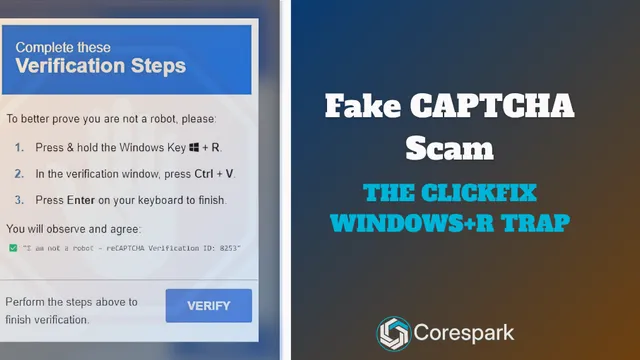
Fake CAPTCHA Scam: The ClickFix Windows+R Trap Explained
Fake CAPTCHA scams may tell you to press Windows+R, paste a command, and run it. Learn the ClickFix warning signs and wh...

Put Your Antique Shop on the Day-Trip Map
Help antique shoppers plan a stop with accurate hours, useful photos, clear categories, directions, and a website that r...

The Photography Website That Helps Couples Say Yes
A photography website should help clients compare services, see the right work, understand the process, and take the nex...