

What Happens When You Ask for Technology Help?
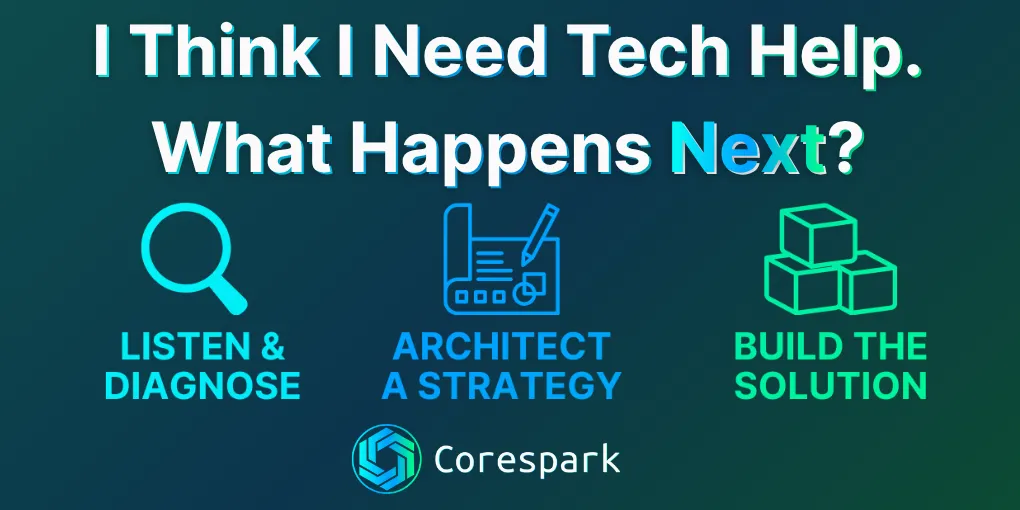
What happens during a technology consultation?
A useful technology consultation should start with the business problem, not a product pitch. The conversation should make room to listen, map a few possible approaches, and agree on a right-sized next step. You do not need to choose a software platform or arrive with a finished project plan.
If you are not sure how to describe the problem, start with our guide to explaining a technology problem without the tech terms. It is completely fine to begin with a frustrating task, a missed handoff, or a process that has outgrown the tools around it.
Step 1: Listen to the problem
The first step is understanding what happens today. That means walking through the task from the first trigger to the final result, including the exceptions that make the process harder than it looks from the outside.
Useful questions include:
- Who starts the process, and who needs the result?
- How often does it happen?
- Which steps are manual or repeated?
- Where do mistakes, delays, or missed follow-ups happen?
- What have you already tried?
Bring screenshots, sample forms, spreadsheets, emails, or a short list of the people involved if they are easy to gather. Do not delay the conversation because you do not have everything. A plain-English description of the task is enough to begin.
Step 2: Map the options
Once the problem is clear, the next step is comparing solutions in the simplest order. A process change may remove the bottleneck. An existing feature may be enough. A pre-built tool may fit with some configuration or integration. Custom software is another option, but it should come after the simpler possibilities have been considered.
This is where a consultation should produce useful clarity, even if the answer is not a new system. Our IT and software consulting service follows that same idea: understand the workflow first, then recommend the tool or change that fits it.
For a related way to evaluate the decision, see how to measure the value of a technology investment. The point is not to force every benefit into a perfect number. It is to make the tradeoffs visible before work begins.
Step 3: Build or implement the next step
After you choose an approach, the work should have a clear boundary. That might mean configuring software, connecting existing systems, documenting a process, or building a focused custom tool.
Before implementation starts, clarify:
- What is included and what is outside the first phase
- Which systems or accounts are involved
- Who will review the work
- How testing will happen
- What training, documentation, and handoff look like
- How future changes or support will be handled
The right timeline depends on the problem, the systems involved, and the amount of testing required. A responsible recommendation explains those dependencies instead of promising the same schedule for every business.
What you should receive before work begins
You should leave the planning conversation with more than a vague promise to “look into it.” A useful written summary identifies the problem, the recommended option, the boundaries of the work, the estimate or pricing format, and the next decision you need to make.
It should also make assumptions visible. If a recommendation depends on access to a vendor account, clean data, a staff owner, or a particular existing feature, those dependencies belong in the plan.
When a consultation is useful
Consider a consultation when a recurring workflow is difficult to explain, difficult to own, or difficult to improve. Common signs include:
- The same information is typed into more than one place.
- A follow-up depends on a sticky note, inbox search, or memory.
- Nobody is sure who owns the next step.
- Different tools contain different versions of the same information.
- A report takes so much manual work that it is rarely produced.
- A process works only because one person knows all the workarounds.
These signs do not automatically mean you need custom software. They do mean the bottleneck is worth mapping before it becomes more expensive to maintain.
Questions to ask any technology partner
Use these questions to compare potential partners:
- What did you understand the business problem to be?
- What simpler options did you consider?
- What is included in the first phase, and what is not?
- Who will own the work after launch?
- How will we test the result with real examples?
- What will we receive for documentation and training?
Clear answers are more useful than a long list of tools or technical terms.
Ready to talk through the problem?
If you have a workflow that feels harder than it should, schedule a general consultation. Bring the problem in your own words. The next step is to understand it well enough to choose a sensible path.
Need a technology partner in the Yadkin Valley?
Corespark helps local small businesses in NC and VA with tech strategy, web development, and more.
Talk to Corespark →More from the Corespark Blog
Fake CAPTCHA Scam: The ClickFix Windows+R Trap Explained
Fake CAPTCHA scams may tell you to press Windows+R, paste a command, and run it. Learn the ClickFix warning signs and wh...

Put Your Antique Shop on the Day-Trip Map
Help antique shoppers plan a stop with accurate hours, useful photos, clear categories, directions, and a website that r...

The Photography Website That Helps Couples Say Yes
A photography website should help clients compare services, see the right work, understand the process, and take the nex...