Does Your Small Business Need Custom Software?
When is custom software worth considering?
Custom software is worth evaluating when a recurring business bottleneck is costly or important and the tools you already have cannot handle it well. That does not mean custom software is automatically the best answer. It means the problem is specific enough to compare a focused build with process changes, configuration, or a pre-built product.
The decision should begin with the work that needs to happen, not with a particular framework or feature list. A technology consultation can help map that workflow before you choose a direction.
Four ways to solve the same business problem
Most technology problems have more than one possible solution. Consider these options in order:
- Change the process. Remove an unnecessary approval, clarify ownership, or document a better sequence.
- Use what you already have. A setting, permission, report, or integration may be enough.
- Adopt a pre-built tool. Choose an existing product when its workflow and tradeoffs fit the business.
- Build custom software. Create a focused tool when the process is important and the available tools leave a meaningful gap.
The smallest option is not always right, but it is usually the best place to start the conversation. Corespark’s pre-built software service and custom software service describe those paths in more detail.
Signs a custom tool may be a good fit
Custom work may deserve consideration when several of these conditions are true:
- Staff rely on repeated workarounds to make current tools fit.
- The same information is entered in multiple systems.
- The business has approval rules or exceptions that standard software cannot represent cleanly.
- A critical handoff depends on one person remembering what to do next.
- The business cannot get a useful report from the systems it already uses.
- The workflow is recurring, stable enough to define, and important enough to maintain.
These signs do not prove that a custom project will pay off. They identify a problem worth investigating more carefully.
Signs custom software is probably not the first step
Custom software is probably not the first step when the process is still unclear, the task happens only once, or the current software has a feature nobody has configured or learned yet. It is also a poor starting point when no one owns the workflow or can review the result.
In those cases, document the process, clarify the desired outcome, and test a simpler change first. The answer may be training, a configuration update, a pre-built tool, or a decision to leave the process alone.
What a small custom project should define
Before anyone writes code, define the boundary of the first version:
- The one problem it is meant to address
- The people who will use it
- The information that goes in
- The result that should come out
- Any integrations it must have
- Permissions and sensitive data considerations
- How success will be checked
- Who will own maintenance and support
- What happens when the normal workflow has an exception
Calling a project “small” is not enough. A focused scope, clear owner, and realistic handoff are what make it manageable.
How to think about cost without guessing
Avoid judging a project by its build price alone. Consider the current cost of the bottleneck, the cost of changing the process, the effort needed to train people, ongoing hosting or support, and what happens if the project is delayed or expanded.
Then ask what evidence would show that the first version helped. That might be fewer duplicate entries, a shorter handoff, better visibility, or less time spent looking for information. Our guide to measuring technology ROI can help you frame those questions without assuming a guaranteed payback.
Start with the bottleneck, not the software
If you are unsure whether the answer is custom software, automation, or a better process, start by describing the bottleneck. Three practical workflow automations show examples of problems that may not require a custom application at all.
When the workflow is still difficult to explain, schedule a general consultation. A good first conversation should help you decide what not to build as well as what may be worth building.
Need a technology partner in the Yadkin Valley?
Corespark helps local small businesses in NC and VA with tech strategy, web development, and more.
Talk to Corespark →More from the Corespark Blog
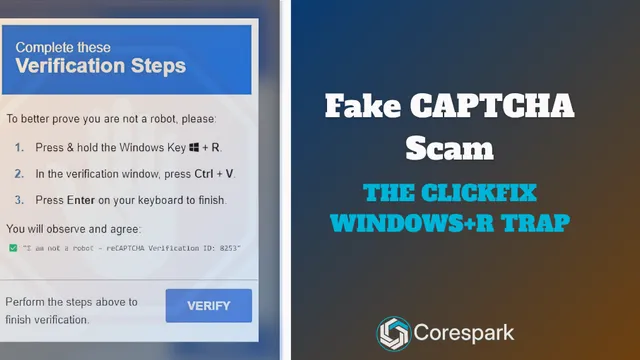
Fake CAPTCHA Scam: The ClickFix Windows+R Trap Explained
Fake CAPTCHA scams may tell you to press Windows+R, paste a command, and run it. Learn the ClickFix warning signs and wh...

Put Your Antique Shop on the Day-Trip Map
Help antique shoppers plan a stop with accurate hours, useful photos, clear categories, directions, and a website that r...

The Photography Website That Helps Couples Say Yes
A photography website should help clients compare services, see the right work, understand the process, and take the nex...